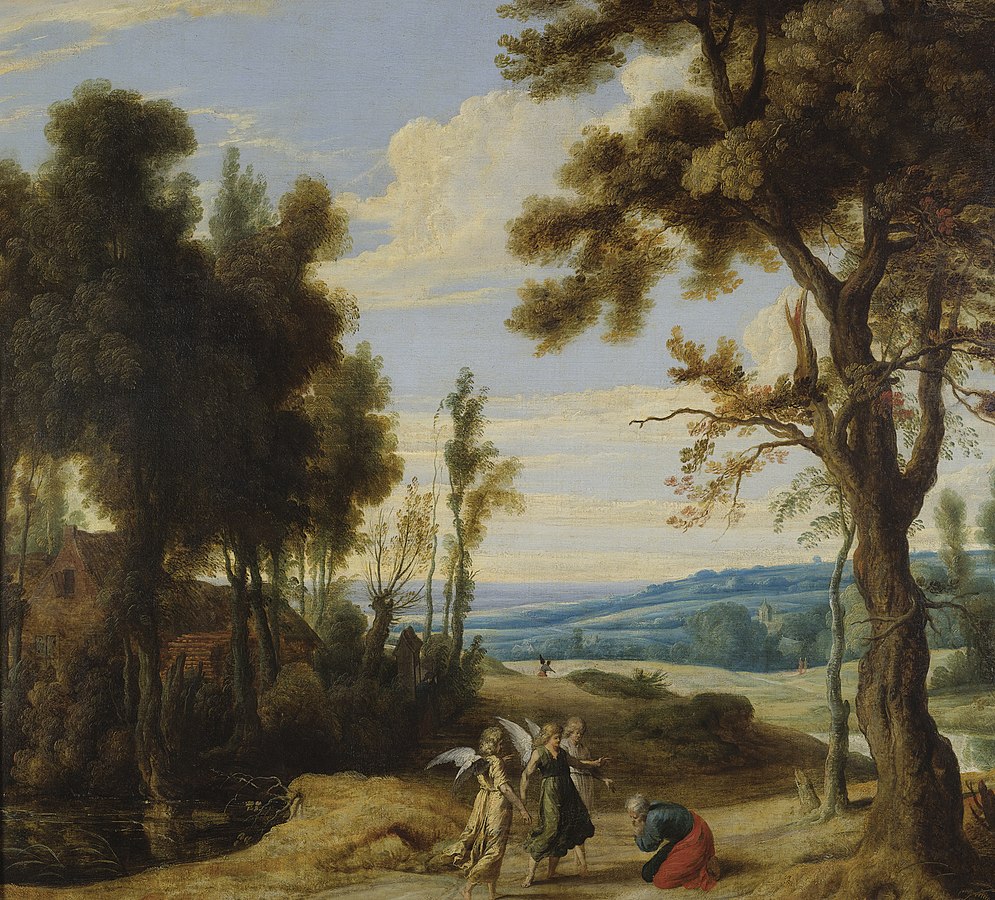
(An exposition of Genesis 18:1-15)
It is a lazy summer day at lunchtime. You are escaping the heat and relaxing in the shade on your front porch. There is a comfortable breeze blowing. Before you slip off into a comfortable doze, you notice three men standing in your yard. Huh, you wonder where they came from. When you see them, you can’t shake the feeling there is something special about these men. You throw all caution to the wind and run to meet them. You even bow before them because you sense they are due some respect. You start barking orders quickly to your wife to start rustling up some lunch, but your orders are for more than just a lunch. It ends up being more like a Thanksgiving meal.
Perhaps this sounds unbelievable, but such was the experience of Abraham and Sarah. They were visited by three extraordinary people, one of whom was the Lord. Verse 1 tells us as much, “And the Lord appeared to him by the oaks of Mamre, as he sat by the door of his tent in the heat of the day.” What would you do if the Lord and a couple of angels showed up at your home at dinnertime? This is indeed a peculiar incident in the life of Abraham. Why is it included in the Scripture? Is it to teach us to show hospitality because we might be entertaining angels unawares, as Heb. 13:2 says? Perhaps, but I believe there is a deeper reason. In this event in the life of Abraham, God asks Sarah a question that echoes through the ages. In every period of history, humans face a God who asks, “Is anything too hard for the Lord?” The answer to this question is no. However, we don’t always believe that in practice.
So what happens when God shows up for dinner?
When God shows up for dinner, it is a:
Covenantal Meal.
The only other place in Scripture where we see the Lord eating with people is when Jesus comes in the flesh. God makes a special appearance and eats a special meal with his special people. Often, when business people make an agreement with one another, they have a meal together. They will seal the deal with a meal. Although God having a meal with Abraham is more spectacular than a business dinner, it is God sealing the deal with a meal. Abraham received the sign of the covenant in circumcision, and now God is having a covenant meal with Abraham to seal the deal. The covenantal function of this meal was to restate the promise of a son through Sarah.
When Jesus institutes the Lord’s Supper with his disciples, he has a covenant meal with them. He says to them and us, “This cup is the new covenant in my blood.” He has this meal personally with his disciples. When he comes again, we will have this meal with him face to face, just as Abraham dined with the Lord by the oaks of Mamre. This is why the Lord’s Supper is so important and so special in the life of a church.
This dining with his people is more than just a covenant meal. It is a:
Display of his intimacy with his children.
God’s desire for intimacy with His children is a beautiful truth. He’s not a distant ruler but a loving Father who longs to share a meal with His beloved. His promise to Abraham and Sarah is a family promise, a testament to His deep, personal connection with us. What better way to express this intimacy than through a shared meal?
We can experience this same kind of intimacy with God today. Through Christ, he has made it possible for us to have the most intimate relationship—a family relationship—he is our Father, and we are his children. When we eat the Lord’s Supper, we express our absolute dependence on Christ to sustain us spiritually, mentally, and physically. He fulfills all our needs.
What about Sarah?
What do we learn from God’s encounter with Sarah?
During the meal, God asks Abraham, “Where is Sarah your wife?” Abraham answers, “She is in the tent.” The Lord said, “I will surely return to you about this time next year, and Sarah your wife shall have a son.” Sarah is sitting in the tent behind the Lord. Moses reminds us in verse 11 that Sarah is a post-menopausal woman—the way of women had ceased with Sarah. So, how does Sarah respond to all this? She laughs to herself. It was a cynical, disbelieving laugh under her breath. She is worn out and old, she reasons. This will never happen to her.
We have to note this minor detail. Sarah laughed to herself. She did not laugh out loud. The Lord is sitting and eating with Abraham. He has his back turned toward Sarah. Why are these details important?
With Hagar, we learn that he is a God who sees. With Sarah we learn he is a God who sees inside us.
Most of the time, I think we realize this. God knows everything. Yet, it is helpful to remind ourselves. God sees inside me, inside you. The Psalmist sings about this:
O LORD, you have searched me and known me!
You know when I sit down and when I rise up;
you discern my thoughts from afar.…
Even before a word is on my tongue,
behold, O LORD, you know it altogether. (Ps. 139:2,4)
God never wonders about anything. He is not sitting in heaven wondering what we will do next. He knows what we are thinking and what we will do. There is only one appropriate response to such truth: worship. We must bow before a God who sees all and knows all. We cannot hide from him, even though we try.
You have to love God’s reply to Sarah: “Is anything too hard for the Lord?” This question, my friends, reverberates through every period of history. Every true believer, every follower of Christ, is faced with this question: “Is anything too hard for the Lord?”
God tells Sarah, “At the appointed time, I will return to you about this time next year, and Sarah shall have a son.” Sarah denies laughing. God, however, has the last laugh. He says, “No, but you did laugh.” The following year, Isaac (laughter) is born. God, indeed, has the last laugh.
So, what can we learn from this question? How can we apply this question to our lives?
Whenever we doubt our salvation or any of God’s promises, we must ask ourselves, “Is anything too hard for the Lord?”
The answer, of course, is no. Nothing is too hard for the Lord. Nothing is too wonderful, too majestic, and too incredible for God. I have to caution you. This question is not some carte blanche promise of getting anything you want whenever you want it. This is not some declaration to satisfy our sinful greed but to satisfy our spiritual need. This question is asked in the context of God’s promise to save and redeem a people for himself. God accomplishes this promise in the most miraculous and incredible way. He brings a son through a man and a woman too old to have children. He preserves his people through persecution, exile, and dispersion worldwide. He brings a son through a virgin who brings the blessing to all nations. He satisfies the deepest need of my heart to know and be known by God. He makes us children of God.
But I doubt, I question, I wonder. I fall into sin and wonder, will God still save me? And God says, “Is anything too hard for the Lord?” I look at all the challenges we face as a church in a culture hostile to the gospel, and I am overwhelmed. I wonder, I doubt, I question. Are you continuing to build your church, Lord? And God says, “Is anything too hard for the Lord?”
I cry out to God to send his Spirit to his church and revive us again, as the Psalmist says, “So that your people may rejoice in you” (Psalm 85:6). The Spirit tarries, time passes, and nothing happens. I wonder. I question. Will revival come in my lifetime? Are you done with your church in America? And God says, “Is anything too hard for the Lord?”
Conclusion
God is with us. He is beckoning you to stop running and stop hiding. He desires intimacy with you. He not only sees you, he sees inside of you. He knows you, and he still wants to know you. He calls out to you even in your unbelief and asks the question echoing through the ages, “Is anything too hard for the Lord?”
 The Established Path of Discipleship
Leave a comment